Reviewed · CITY TOURS
Tacloban City and Palo Leyte Town Tour
War memories meet typhoon resilience here. This six-hour private drive brings together MacArthur Park and San Juanico Bridge, two of Leyte’s best-known sights, while also making room for churches, government buildings, and memorials tied to Typhoon Yolanda. I like the mix of major landmarks and quieter civic sites, and I like that the trip includes a guide, private transport, and bottled water. The main drawback is the pace: ten listed stops in about six hours means several visits are brief.
A booking note specifically praises guide Marc for his clear English, patience, and useful explanations, while Daniel is praised for driving. Hotel pickup and drop-off were also provided in that case, although the stated meeting point is D. Z. Romualdez Airport, so I would confirm your exact pickup location before booking. The tour is listed at $54 per group of up to one, with a $27 regional tour guide fee not included, so check the final total carefully if you are booking for more than one person.
In This Review
- Five things to know before you book
- Why this route works for a first visit
- Leyte Landing Memorial: MacArthur’s return
- Palo Cathedral and the memory of Yolanda
- The Leyte government complex in Palo
- San Juanico Bridge: the big view of Leyte and Samar
- M/V Eva Jocelyn Shrine and the Yolanda story
- Santo Niño Shrine and Heritage Museum
- Madonna of Japan and the bridge between former enemies
- Leyte Provincial Capitol and the return of government
- Santo Niño Church and Tacloban City Hall
- The Yolanda memorial sites and an important timing question
- What the $54 price really gives you
- Who should book this experience?
- FAQ
- How long does the Tacloban and Palo tour last?
- Where does the tour start?
- Does the tour return to the starting point?
- Is transportation included?
- Is a guide included?
- Is this a private tour?
- What is the cancellation policy?
- Should you book the Tacloban and Palo tour?
Five things to know before you book
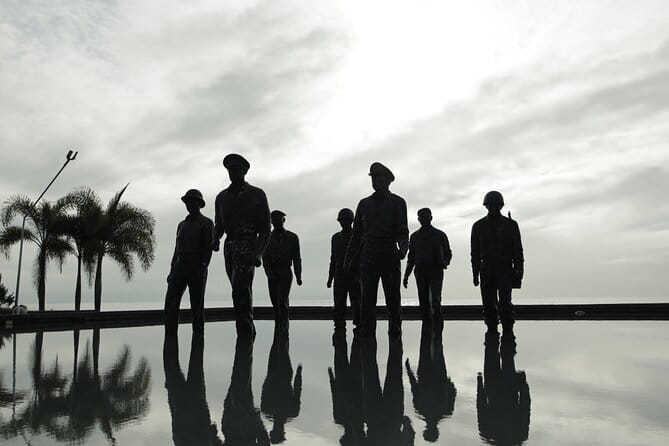
- MacArthur Park connects Leyte to October 20, 1944: Bronze figures show General Douglas MacArthur returning with Sergio Osmeña, Carlos Romulo, and four soldiers.
- San Juanico Bridge links Leyte and Samar: The 2.6-kilometer crossing gives the tour its biggest engineering sight and a clear sense of the two-island setting.
- Palo Cathedral carries both wartime and Yolanda memories: It served as a hospital in World War II and later offered refuge after the 2013 typhoon.
- The Santo Niño Shrine takes a full hour: This is the tour’s main indoor visit, with a museum built from 1979 to 1981 by Imelda Marcos.
- This is a private, guide-led route: You travel only with your own group, with an English-speaking in-person guide and transport included.
Why this route works for a first visit
Tacloban and Palo are not places you understand from a single postcard stop. Their story runs through World War II, Philippine government, Catholic faith, political power, and the destruction caused by Super Typhoon Yolanda in 2013.
This tour puts those subjects side by side. You might begin at a war memorial, pass through a church that treated wounded soldiers, cross a bridge built during the Marcos era, and then pause beside a ship swept inland by a storm. That range gives the day its value.
I especially like the private format. You are not tied to a large group, and the guide can potentially give more attention to your questions. The schedule still moves briskly, but private transport makes it easier to cover Palo and Tacloban without arranging several separate rides.
The tour is also practical if you have only one day in the area. Pickup is offered, mobile tickets are accepted, and most people can participate. The stated start and end point is D. Z. Romualdez Airport, though hotel pickup was provided in the booking feedback available for this experience. Ask about that point directly rather than assuming it is included everywhere.
More City Tours in the Philippines:
- Cebu City: Whale Shark Swimming & Kawasan Falls Canyoneering
★ 4.7 · 665 reviews - Cebu City: Bohol Countryside Tour with Loboc Cruise Lunch
★ 4.5 · 488 reviews - Manila: Old & New 4-Hour City Tour
★ 4.5 · 458 reviews
Leyte Landing Memorial: MacArthur’s return
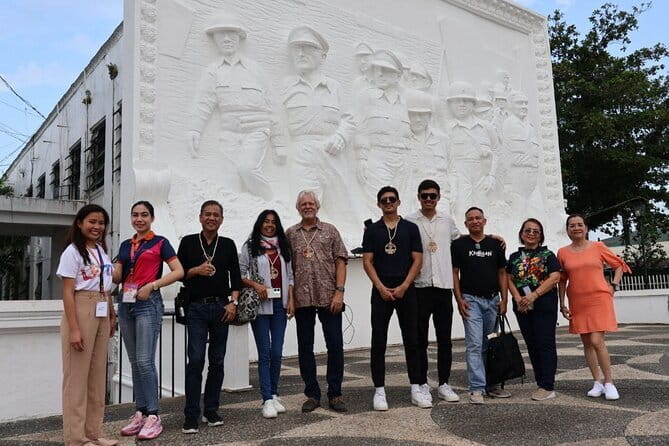
The Leyte Landing Memorial, commonly called MacArthur Park, is the emotional opening to the tour. The bronze group shows General Douglas MacArthur stepping ashore on October 20, 1944, fulfilling his promise to return to the Philippines.
He is joined by President Sergio Osmeña, General Carlos Romulo, and four Filipino soldiers. In front of the statues, a marble wall carries MacArthur’s famous promise. The park was named a National Historical Landmark in 2004.
You get about 20 minutes here, and that is enough for the main monument, photographs, and a short explanation. I would listen closely to the guide because the figures are not just decorative. They represent the Allied return and the Filipino leadership that accompanied it.
The short visit is also the limitation. This is a symbolic site more than a museum, so anyone hoping for a large collection of artifacts will not find that here. Its strength is the setting and the story told by the statues themselves.
Palo Cathedral and the memory of Yolanda
The Transfiguration of Our Lord Cathedral, usually called Palo Cathedral, gives the tour a more personal feel. During World War II, it served as a hospital for wounded people from October 1944 through March 1945.
The church was badly damaged by Typhoon Yolanda in November 2013, yet its grounds became a refuge for survivors. Those same grounds also became the burial place for people who died in the storm.
Pope Francis visited on January 17, 2015, and blessed the grave site. The cathedral was also declared a pilgrim church of the archdiocese in 2015. You have about 30 minutes here, which allows time to take in the building, grounds, and explanation without turning the visit into a rushed photo stop.
This is one of the most meaningful parts of the route, but it calls for respectful behavior. The site is an active religious place and a memorial to disaster victims, not merely a sightseeing backdrop.
The Leyte government complex in Palo
The Leyte New Provincial Capitol sits in Barangay Guindapunan, Palo, inside a 14-hectare provincial government complex. It replaced the old capitol after damage from the 2013 storm surge and a 2019 earthquake.
The complex offers Segway tours around its historic points, though this Tacloban and Palo trip is described as a private vehicle tour rather than a Segway excursion. You get roughly 30 minutes here.
For me, the interest is less about the modern building itself and more about what it tells you about recovery. Public buildings in Leyte are part of the story of rebuilding after Yolanda. The stop also gives you a look beyond the usual church and monument circuit.
Do not expect a long interior tour based on the details provided. The schedule suggests a short orientation and photo stop, with the guide supplying the context.
A completely different kind of day out:
- El Nido: Island Hopping Tour A Lagoons and Beaches
★ 4.3 · 1,572 reviews - From Puerto Princesa: Underground River Full-Day Trip
★ 4.3 · 1,460 reviews - Bohol: Premium Chocolate Hills, Tarsiers & River Experience
★ 4.7 · 804 reviews - Coron Ultimate Tour: 7 Destinations with Lunch & Transfers
★ 4.8 · 754 reviews
San Juanico Bridge: the big view of Leyte and Samar

San Juanico Bridge is the route’s most obvious engineering spectacle. It stretches 2.6 kilometers across the San Juanico Strait, connecting Tacloban City on Leyte with Santa Rita on Samar.
It was the longest bridge in the Philippines until the Cebu-Cordova Link Expressway opened in 2022. Built in 1969 during the Marcos administration, it was originally called the Philippine-Japan Friendship Bridge and was funded through Japanese Official Development Assistance loans.
The bridge also carries political history. Some accounts argue that it was not built only as a public project, but also as a gift from Ferdinand Marcos to his wife, Imelda Marcos. That makes the bridge a useful place to ask your guide about how public works, political image, and national memory overlap.
The stop lasts about 30 minutes. You should have time to appreciate the crossing and take photographs, but the schedule does not promise a long walk along the bridge. Follow the guide’s instructions about where it is safe and appropriate to stop.
M/V Eva Jocelyn Shrine and the Yolanda story
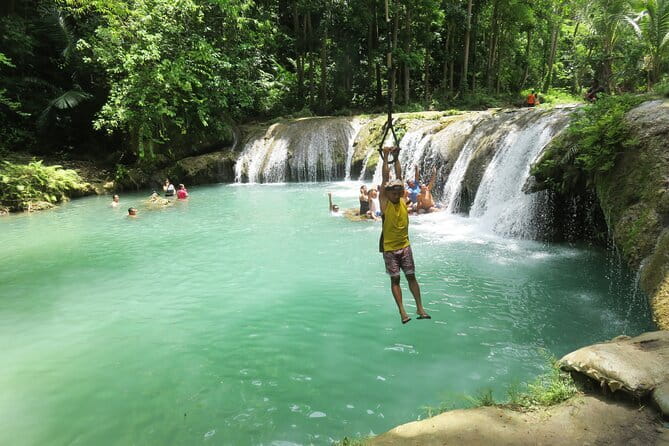
The M/V Eva Jocelyn Shrine is one of the route’s most striking reminders of Typhoon Yolanda. The ship came from Basey, Samar, and the storm pushed it into Barangay Anibong in Tacloban City.
You get only 15 minutes here, but the object itself does much of the explaining. A ship left far from the water is a powerful image of the storm’s force. The shrine honors people who died and the strength shown by those who survived.
I would not treat this as a casual stop. Take the time to understand why the ship is here, then allow space for the memorial’s quieter mood. The short visit works if your goal is to see the site and hear its story, though it may feel too brief if disaster history is your main reason for visiting Tacloban.
Santo Niño Shrine and Heritage Museum
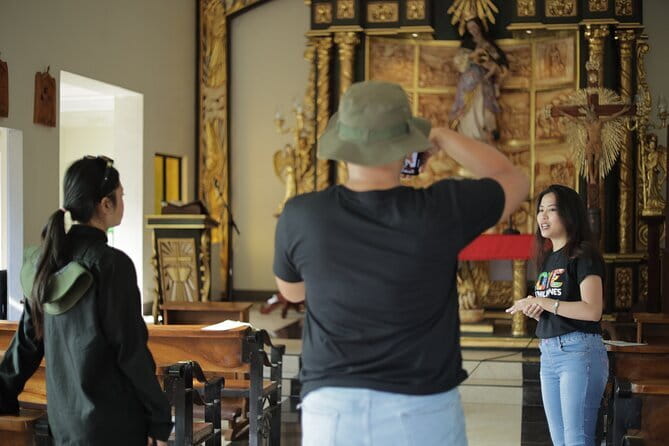
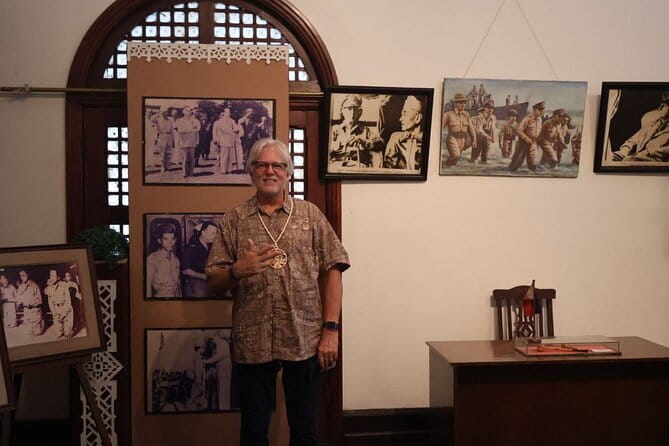
The Santo Niño Shrine and Heritage Museum is the longest stop, with one hour set aside. It is also commonly called the Imelda Marcos Museum.
The building was constructed from 1979 to 1981 by Imelda Marcos, then First Lady and wife of President Ferdinand Marcos. It was formerly owned by the Marcos family and now houses a museum.
This stop adds a different layer to the day. At MacArthur Park, you are looking at wartime liberation. At the shrine museum, you are confronting the political and cultural world of the Marcos era through a building connected directly to the family.
The one-hour visit matters because an indoor museum needs more time than a roadside monument. Your guide can help place the building in Tacloban’s wider story, though the supplied details do not specify the individual displays or rooms. If you have strong interest in Philippine politics, art, or the Marcos period, this may be the stop that deserves your closest attention.
Madonna of Japan and the bridge between former enemies
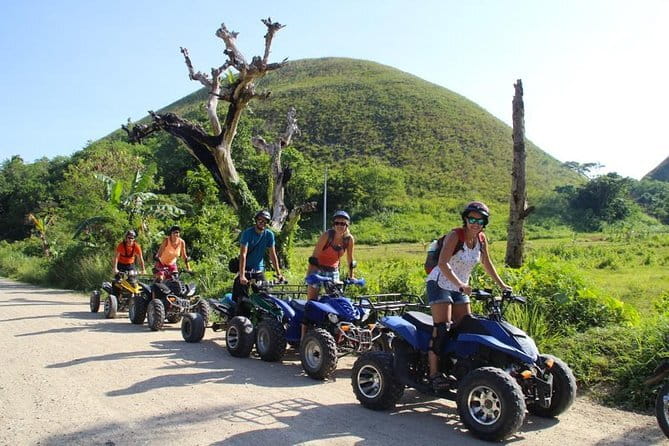
The Madonna of Japan monument was erected 33 years after World War II as a symbol of friendship between Japanese and Filipino people. Leyte was a major battlefield during the war, and local people suffered heavily.
The monument also recognizes soldiers who fought and died in Leyte. Its message is about former enemies developing friendship and supporting one another’s future.
Only 10 minutes are planned here. That is enough for a quick look and a short explanation, but not a long historical discussion. I would use this stop to connect the war memorials with the later relationship between Japan and the Philippines.
Leyte Provincial Capitol and the return of government
The Leyte Provincial Capitol Building gives the tour one of its strongest political-history moments. It served as the seat of Leyte’s provincial government until 2019.
During World War II, it was damaged during the Japanese occupation. From October 23, 1944, to February 27, 1945, the building served as the temporary national capitol while Allied forces liberated the Philippines.
Inside, General Douglas MacArthur swore in Sergio Osmeña as President of the Philippines. That detail turns a ten-minute stop into more than a quick government-building photograph. You are looking at the place where national leadership changed during a major turning point.
The short timing means you should depend on the guide’s narration. There is no indication of a full interior tour, so confirm what access is available on the day.
Santo Niño Church and Tacloban City Hall
The Santo Niño Church is dedicated to the Miraculous Santo Niño de Tacloban, a centuries-old image revered as the protector of Leyte. The church has a tall belfry and remains an important center of Catholic life in Tacloban.
You have about 20 minutes here. The stop is valuable for seeing how faith fits into local identity, especially after visiting sites shaped by war and disaster. Around 70 percent of Taclobanons are Catholic, according to the supplied information, so this is not a minor side note in the city’s story.
Tacloban City Hall follows with a 10-minute visit. Established on June 12, 1952, it has served as the center of local government operations. Together, the church and city hall show two basic parts of civic life: religious devotion and public administration.
Both stops are short. Think of them as guided orientation points rather than extended visits.
The Yolanda memorial sites and an important timing question
The tour overview also highlights the Yolanda Mass Grave and Yolanda Memorial Monument at Tacloban Astrodome. These sites are not given separate time blocks in the ten-stop schedule, so I would ask the operator whether they are included in the actual route on your date.
That question matters because the schedule is already full. If the mass grave or Astrodome memorial is especially important to you, ask how much time will be available and which listed stop might be adjusted.
The route’s treatment of Yolanda is otherwise clear through Palo Cathedral and the M/V Eva Jocelyn Shrine. Still, memorial sites deserve precise planning. A quick pass may not feel adequate for someone coming mainly to understand the 2013 disaster.
What the $54 price really gives you
The listed price is $54 per group of up to one. That wording is unusual, so confirm the charge for your party before paying. A separate $27 regional tour guide fee is not included, which changes the true cost.
At its best value, you are paying for a private vehicle, an English-speaking in-person guide, bottled water, and a carefully arranged six-hour route across Palo and Tacloban. If you tried to organize every stop independently, transport and timing could become a nuisance.
The value is strongest for a solo visitor or anyone who wants a private overview in one day. It is less compelling if you prefer to linger at one or two sites, since many stops last only 10 to 30 minutes.
The only published rating supplied for the experience is five out of five. The accompanying feedback gives useful practical detail: Marc was praised for clear English, patience, and explanations, while Daniel received praise for driving. Hotel pickup and drop-off were also provided in that case. Those details are encouraging, but I would still confirm the guide and pickup arrangement rather than treating them as guaranteed for every booking.
Who should book this experience?
I would recommend it to a first-time visitor with limited time, a solo explorer who wants private transport, or anyone interested in seeing how Leyte’s war, religion, politics, and disaster recovery connect.
It also suits people who prefer a guide’s explanation to a day of navigating unfamiliar roads. The route covers a lot of ground, and the private format lets you ask questions without keeping up with a large group.
I would hesitate if you want a slow museum day, long church visits, or extensive time at memorials. The ten-stop plan is ambitious. You will see many important places, but the cost of that range is limited time at each one.
The tour offers free cancellation up to 24 hours before the start time. Changes or cancellations inside that window are not accepted for a refund, so keep the local cutoff time in mind.
FAQ
How long does the Tacloban and Palo tour last?
The experience lasts approximately six hours.
Where does the tour start?
The stated meeting point is D. Z. Romualdez Airport in Tacloban, Leyte Province, Philippines.
Does the tour return to the starting point?
Yes. The activity ends back at the meeting point.
Is transportation included?
Yes. Private transportation and bottled water are included.
Is a guide included?
An English-speaking in-person guide is included. A separate regional tour guide fee of $27 is listed as not included.
Is this a private tour?
Yes. Only your own group participates in the activity.
What is the cancellation policy?
You can cancel at least 24 hours before the start time for a full refund. Cancellations or changes made less than 24 hours before the start time are not accepted for a refund.
Should you book the Tacloban and Palo tour?
Book it if you want a private, efficient introduction to Leyte’s major landmarks and can accept short visits. MacArthur Park, San Juanico Bridge, Palo Cathedral, the M/V Eva Jocelyn Shrine, and the Santo Niño Shrine each show a different side of the region.
Before confirming, ask two questions: what the total price is for your full group, and whether hotel pickup and the Astrodome Yolanda memorial sites are included on your date. If those details line up, the tour offers solid convenience and a thoughtful range of places in one day.
Just added in the Philippines
- Underground River without Lunch★ 4.7 · 3 reviews
- Underground River with Lunch★ 3.6 · 5 reviews
- Waves & Wonders: Siargao Private Tour M Adventure★ 5.0 · 1 review
- Twin Treasures: Discovering Dumaguete and Valencia★ 3.4 · 5 reviews
- Manila Night market and Street Food Tour★ 5.0 · 2 reviews
- Trekking to see the beautiful view of Cebu City★ 3.3 · 4 reviews
- Sohoton Cave and Natural Bridge Park Adventure Tour★ 5.0 · 1 review
- Tri island tour: Naked Island, Daku Island and Guyman Island★ 5.0 · 3 reviews
City Tours, compared.
Whale Shark Swimming & Kawasan Falls Canyoneering
Read our review →
Bohol Countryside Tour with Loboc Cruise Lunch
Read our review →
Underground River Day Trip from Puerto Princesa City
Read our review →
Private Cebu & Lapu-Lapu City Tour with Uphill Spots & Lunch at House of Lechon
Read our review →
Bohol Countryside Day Tour From Cebu City | Lunch at Loboc River Cruise
Read our review →
Full-Day Manila City, Tagaytay Taal Volcano and Lake Tour
Read our review →