Reviewed · MANILA TOURS
Shared Old Manila Tour
Manila’s past is packed into four busy hours. This small-group tour brings you through Rizal Park, Intramuros, Fort Santiago, San Agustin Church, Casa Manila, and Binondo with an English-speaking guide. I like the maximum of six people, which keeps the tour more personal, and I like that guides such as Jonas, Joan, Richard, and Amy have been praised for making the city’s stories easy to follow.
The route gives you a useful first look at Manila’s Spanish-era core, then adds a horse-drawn calesa ride and a stop in Chinatown. The main consideration is time: four hours is enough for an overview, but not enough for a leisurely visit at every stop. Also, the details say lunch is included while food and drinks are not included, so I would confirm exactly what lunch covers before paying $142.31 per person.
In This Review
- Key points at a glance
- Why this short Manila tour works
- Rizal Park, a brief start with national meaning
- Fort Santiago, where Manila’s past feels most concrete
- San Agustin Church, a compact look at Manila’s oldest stone church
- Casa Manila, a picture of 19th-century home life
- The calesa ride to Binondo
- What the guides add to the experience
- Price, pickup, lunch, and timing
- Who should book this tour
- Should you book the Shared Old Manila Tour?
- FAQ
- How long does the Shared Old Manila Tour last?
- What time does the tour start?
- Is hotel pickup available?
- What is included in the tour price?
- How many people can join the tour?
- Can I cancel for a full refund?
Key points at a glance

- Fort Santiago sets the historical tone: This old fortress at the mouth of the Pasig River is the tour’s main window into Manila’s colonial past.
- Intramuros is explored beyond a drive-by: You walk its cobbled streets and enter San Agustin Church and Casa Manila.
- The calesa ride adds local character: A horse-drawn carriage carries you toward Binondo and Binondo Church.
- The group is capped at six people: That matters when you want to ask questions or adjust the pace.
- Guide quality is a major strength: Jonas, Joan, Richard, and Amy are singled out for clear explanations and a flexible approach.
- The tour mixes landmarks with food culture: Chinatown may include stops for traditional spring rolls and bao buns, though food details should be confirmed.
Why this short Manila tour works
If you have only one morning or afternoon in Manila, this route gives you a sensible starting point. It links the city’s national memorial, Spanish fortifications, religious architecture, old domestic life, and Chinatown in one compact outing.
I like the balance. You are not spending four hours looking only at grand buildings. The route shifts from Rizal Park to the old walls of Intramuros, then from a church and historic house to the streets of Binondo. That change of mood helps you understand Manila as a layered city rather than a collection of disconnected sights.
The small group is important. With no more than six people, you should have a better chance to hear the guide, ask about details, and request clarification when a name or date becomes confusing. The guide is not simply there to point at buildings. Jonas has been praised for explaining Filipino culture as well as history, while Joan was noted for discussing landmarks, food, and local customs.
The four-hour length is both an advantage and a limit. It fits neatly into a busy Manila schedule and avoids turning a first introduction into an all-day commitment. On the other hand, each stop has a short time allowance, and traffic can affect the transfers. You should think of this as a well-planned orientation, not a slow museum day.
A few more Manila days worth comparing
- Intramuros, Manila: Historical Bamboo Bike Tour
★ 4.8 · 583 reviews - Experience Intramuros with Bamboo Bicycle – Ecotours
★ 5.0 · 508 reviews - Manila: Intramuros, Chinatown, and Old Manila Half-Day Tour
★ 4.8 · 475 reviews
Rizal Park, a brief start with national meaning
The tour begins with a picture stop at Rizal Park, named for Dr. Jose Rizal, the Philippines’ national hero. The visit is brief, so you should not expect a long guided walk through the park. Its purpose is to place the rest of the morning in a national context.
That short stop can still be useful. Rizal is central to the country’s public memory, and beginning here gives your guide a natural way to explain the people and events that shaped the Philippines. If you are unfamiliar with Filipino history, listen closely during this opening section. It will make the later stops at Fort Santiago and Intramuros easier to understand.
The practical point is simple: keep your camera ready and your expectations realistic. This is a photo stop, not a full park visit.
Fort Santiago, where Manila’s past feels most concrete
Fort Santiago receives about 30 minutes, with admission included. The fortress sits at the mouth of the Pasig River and has witnessed major moments in Philippine history. Of all the stops, this is probably the one that gives the clearest sense of Manila’s military and colonial past.
I appreciate the way a fort can make history easier to grasp. Walls, gates, and defensive spaces show you how the city was protected and controlled. You are not just hearing about Spanish rule in the abstract. You are standing inside one of its most important physical remains.
Thirty minutes is enough for an introduction, especially with a good guide, but it is not enough to inspect every corner at a relaxed pace. Stay close during the explanation, then use your free moments for photographs. If military history is your main interest, you may wish you had longer here. For a first visit, though, the stop earns its place.
The guide’s role matters greatly at Fort Santiago. Richard and the driver were praised for explaining Manila’s past clearly, while Jonas was credited with following the route closely and adding useful context. Those comments suggest that the quality of the narration can make the difference between a quick fortress visit and a meaningful one.
San Agustin Church, a compact look at Manila’s oldest stone church
Next comes San Agustin Church, reached through Intramuros’ cobbled streets. The tour allows about 15 minutes, and admission is included. It is described as the oldest stone church in the Philippines, with ecclesiastical icons, vestments, and other religious objects on view.
This stop is short, but the setting does much of the work. Walking over cobbles toward an old church gives you a strong sense of the Spanish-built quarter. Inside, the religious collection adds detail to the architecture and shows how faith, art, and colonial life were tied together.
Fifteen minutes can feel rushed if you want to study every object. I would treat this as a focused introduction. Let the guide explain what you are seeing, then take a moment to look at the church’s interior before the group moves on.
You should also expect a religious site rather than a general museum. Dress and behavior should be respectful, and the pace may depend on what is happening at the church. The tour is subject to favorable weather, and traffic can alter the timing of transfers, so the schedule should be viewed as approximate rather than fixed to the minute.
A completely different kind of day out:
- Manila: Old & New 4-Hour City Tour
★ 4.5 · 458 reviews - Manila Old and New: Sightseeing Tour Including Intramuros and Fort Santiago
★ 4.5 · 377 reviews - Spectacular Manila to Tagaytay: Full-Day Sightseeing Tour
★ 5.0 · 349 reviews - Makati Nightlife: VIP Access to Clubs, Rooftops & Go-Go Bars
★ 4.9 · 278 reviews
Casa Manila, a picture of 19th-century home life
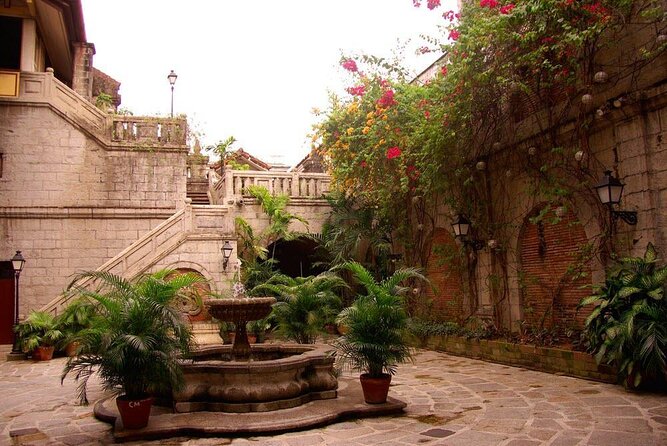
Across the street, Casa Manila recreates a 19th-century house. The rooms combine Oriental and European decoration with Philippine antique furniture, and the visit lasts about 30 minutes.
This is a useful counterpoint to Fort Santiago and San Agustin Church. Fort Santiago shows power and defense. San Agustin shows religious life. Casa Manila turns your attention to domestic space, furniture, decoration, and the way different cultural influences appeared inside a historic home.
The word reproduction matters. Casa Manila is not presented as an untouched original house. Its value comes from showing you a carefully arranged picture of 19th-century life. That makes it easier to understand how Manila’s upper-class homes may have looked and how Asian, European, and Philippine influences could exist in the same rooms.
Thirty minutes gives you enough time to move through the house without lingering over every piece of furniture. I like this stop for visitors who want more than fortresses and churches. It adds human scale to the tour.
The calesa ride to Binondo
After Intramuros, you board a calesa, a traditional horse-drawn carriage, and travel toward Binondo. The ride crosses the Pasig River and continues toward an alley leading to Binondo Church, a historic landmark built by the Spanish.
This is the route’s most distinctive change of pace. After walking through formal colonial sites, you shift into a mode of transport connected with old Manila. The ride is not just a practical transfer. It gives the tour a more local texture and breaks up the sequence of indoor visits.
The published stop at Binondo Church is about 15 minutes, with no admission charge. That is enough for a quick look and an explanation, but not a full exploration of Chinatown. If you hope to spend hours eating, shopping, and photographing the district, this tour will only give you an introduction.
One useful detail comes from Jonas’s tour: the Chinatown portion included stops at two food stalls for traditional spring rolls and bao buns. That sounds like exactly the kind of small addition that improves a short city tour. Still, it is not guaranteed in the stated inclusions, so ask if food tastings are part of your departure.
What the guides add to the experience
The strongest praise for this tour centers on the guides. Jonas is described as extremely well informed and as someone who connected major sights with Filipino culture. Joan was engaging and thoughtful when discussing historic landmarks, food, and everyday culture.
Richard and the driver were also praised for their command of Manila’s past. Amy was described as clear, charming, and flexible about the group’s interests. That last point is especially valuable on a small-group tour. If the group wants more explanation at a particular site, a flexible guide can make the four-hour route feel less rigid.
Of course, guide assignments can change. You should not book on the assumption that one named person will lead your tour unless the operator confirms it. But the pattern is encouraging: the experience depends on explanation, and the available feedback gives the guides high marks for both facts and personality.
I would ask questions. Manila has many unfamiliar names, dates, and political references, and a small group gives you room to ask what a building means today, not just when it was built.
Price, pickup, lunch, and timing
At $142.31 per person, this is not a budget walking tour. The price needs to cover more than admission: selected-hotel pickup and drop-off, a professional guide, transport between areas, the calesa ride, and the convenience of a small group all form part of the value.
The tour also includes taxes, fees, and handling charges, so you are less likely to face added costs for those items. Admission is included at Fort Santiago, San Agustin Church, and Casa Manila. Binondo Church has no admission fee.
There is one detail I would clarify before booking. The inclusions list says lunch is included, while the exclusions say food and drinks are not included. Those statements do not fully match. Ask the operator whether lunch means a set meal, a limited food allowance, or something else, and budget for drinks and any Chinatown snacks unless told otherwise.
Pickup is offered only at selected hotels. The published start time is 8:00 am, although the tour is also described as having morning or afternoon departure choices. Confirm your exact pickup time and location after booking. Hotel transfers can take longer depending on traffic, and the total duration is approximate.
The tour is usually booked about 10 days ahead, which is a useful sign for planning. I would reserve early if your Manila schedule is tight, especially because the group limit is six.
Who should book this tour
I would recommend it to a first-time visitor who wants a guided introduction to old Manila without arranging several separate admissions and transfers. It suits you especially well if you enjoy historical buildings but also want a little local food culture and a traditional ride.
It can work for families because most people can participate, but children must be accompanied by an adult. The child rate applies only when the child shares with two paying adults. That rule is worth checking before you book for a family group.
This tour is less suitable if you prefer to set your own pace. The church visit lasts about 15 minutes, and the Binondo portion is also brief. You may feel hurried if your main goal is detailed photography, extended museum time, or a long Chinatown meal.
It is also not a good choice for a missed cruise arrival. The conditions state that a refund will not be issued if you miss the tour because your cruise ship arrives late or does not arrive. If you are coming from a ship, leave a generous margin or choose an experience that is less dependent on a fixed departure.
Free cancellation is available when you cancel at least 24 hours before the start time. Changes or cancellations inside that window are not accepted for a refund.
Should you book the Shared Old Manila Tour?
Book it if you want a compact, guided introduction to Manila’s old quarter, especially with hotel pickup, included admissions, and a group capped at six. The strongest reason to choose it is the guiding. Jonas, Joan, Richard, and Amy are praised for making buildings, food, and Filipino culture understandable rather than merely listing dates.
The main tradeoff is price and pace. At $142.31, you are paying for convenience, transport, a guide, and a small group, not just entry tickets. At four hours, the tour gives you the outline of Manila’s past, then leaves you to return later if one place catches your interest.
I would choose this for a first day in Manila, confirm the lunch details, and ask which departure time and guide are assigned. If you want a friendly overview with Fort Santiago, Intramuros, Casa Manila, and a taste of Binondo in one outing, it is a strong choice.
FAQ
How long does the Shared Old Manila Tour last?
The tour lasts approximately four hours. Transfer times can vary with traffic and time of day.
What time does the tour start?
The stated start time is 8:00 am. The experience is also described as offering a choice of morning or afternoon departure, so confirm your selected departure when booking.
Is hotel pickup available?
Hotel pickup and drop-off are available at selected hotels only.
What is included in the tour price?
The price includes taxes, fees, handling charges, a professional guide, selected-hotel pickup and drop-off, and admission to the included attractions. Lunch is listed as included, but food and drinks are also listed as excluded, so confirm the lunch details before booking.
How many people can join the tour?
The activity has a maximum of six participants.
Can I cancel for a full refund?
Yes. You can cancel for a full refund if you do so at least 24 hours before the experience start time. Cancellations or changes made less than 24 hours in advance are not refunded or accepted.
Just added in Manila
- Underground River with Lunch★ 3.6 · 5 reviews
- Manila Night market and Street Food Tour★ 5.0 · 2 reviews
- Cruise Shore Excursion of Taal Volcano with Lunch★ 4.5 · 4 reviews
- Ultimate 8-Day Palawan Island Tour Package from Manila City★ 5.0 · 1 review
- Unforgettable Manila Fishing Village Day Excursion 2024★ 5.0 · 4 reviews
- Tagaytay + Hidden Valley Springs: A Scenic Escape w/ Transfers★ 4.0 · 4 reviews
- Tagaytay Day Tour sightseeing with Panoramic Taal volcano view★ 5.0 · 6 reviews
- 3 Days Private Tour in Banaue Ifugao visiting Batad Rice Terraces★ 3.5 · 3 reviews
Manila Tours, compared.

Intramuros, Manila: Historical Bamboo Bike Tour
Read our review →
Experience Intramuros with Bamboo Bicycle – Ecotours
Read our review →Intramuros, Chinatown, and Old Manila Half-Day Tour
Read our review →
Manila Old and New: Sightseeing Tour Including Intramuros and Fort Santiago
Read our review →
Spectacular Manila to Tagaytay: Full-Day Sightseeing Tour
Read our review →
Makati Nightlife: VIP Access to Clubs, Rooftops & Go-Go Bars
Read our review →
Discover Tagaytay’s Countryside: Half-Day Sightseeing Tour
Read our review →